By Mike Simmons, Co-Founder & COO
ARTAK Block 3: What's New in Eolian's 3D Staff Planning Environment
ARTAK Block 3 turns the 3D map into a staff planning environment: 200+ weapon systems with enforced real ranges, thousands of MIL-STD-2525E symbols, and six new base maps.
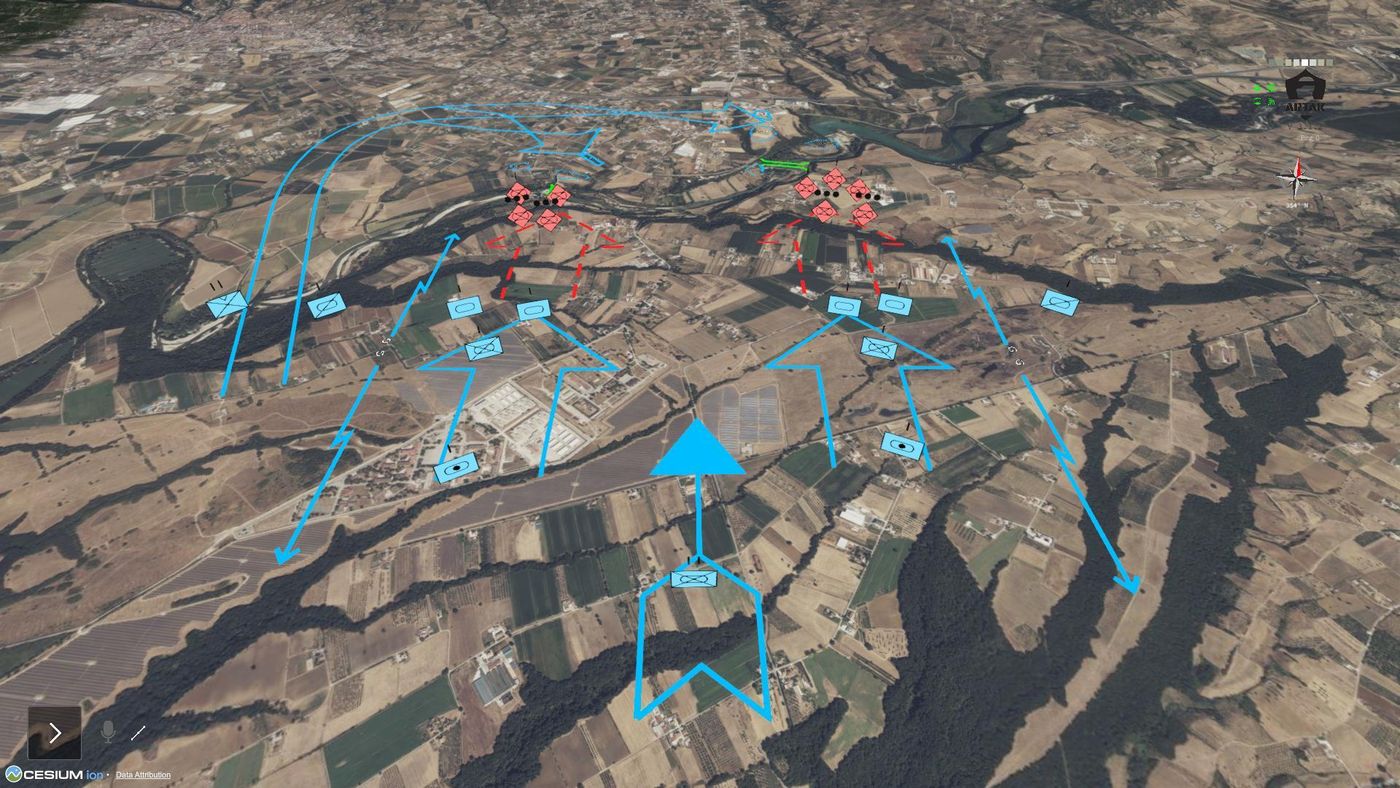
ARTAK Block 3 is the release that turns ARTAK from a shared 3D map into a full staff planning environment. Block 1 put a high-quality 3D map in an operator's hands at the edge. Block 2 let units build those maps themselves, without a network. Block 3 adds what a battle staff needs to work on top of the terrain: doctrinal symbology at higher echelons, weapon systems that carry their real ranges and refuse to be placed beyond them, an eye-level Immersion Mode, and six new base maps.
The one-sentence version: in ARTAK Block 3, you cannot drag a weapon farther than it can actually shoot.
This post covers what changed, why each change matters to a planning cell, and how to get Block 3. For the platform itself — what ARTAK is, what it runs on, and how it federates with the TAK ecosystem — start with What Is ARTAK?.
The Weapon Inventory: fires planning that enforces physics
Block 3 introduces the Weapon Inventory: 200+ U.S. weapon systems — the top ten in each category, from surface-to-air to bombs — each carrying its real range, engagement envelope, and blast radius.
The data is the easy half. The feature is the enforcement. ARTAK will not let a planner place a weapon beyond its actual range. A fires plan built in Block 3 behaves the way the physics does, which means coverage gaps show up as gaps rather than as assumptions. A plan that does not close is obvious to everyone standing in the terrain before anyone briefs it.
That inverts the usual sequence. On a flat product, a seam in coverage is something a fire support officer finds by checking — sometimes after the rehearsal, sometimes not at all. In Block 3, the seam is visible geometry. Nobody has to catch it, because nobody can draw over it.
Engagement areas, final protective lines, obstacle belts, and target reference points all sit in the same volumetric space as the terrain that masks them, so terrain masking is something the plan accounts for instead of something the plan discovers.
Doctrinal symbology built to MIL-STD-2525E
Block 3 adds thousands of new icons, nodes, symbols, maneuvers, and control measures built to MIL-STD-2525E, including the Table L-XXI mission and operation task symbols. The emphasis is on higher-echelon graphics, so brigade, division, and joint staffs get the fidelity tactical users have had since Block 1.
The second change is render-through. Symbols and control measures now draw through buildings and terrain, so a boundary, a phase line, or a target reference point never disappears behind a ridgeline or a rooftop. In dense urban and mountainous terrain that is the difference between a graphic being present and a graphic being usable.
Products built in ARTAK are doctrinally correct, which matters downstream: a graphic drawn in ARTAK is legible to a staff officer who has never seen the software and transferable to the C2 systems the unit already runs.
Immersion Mode: walk the objective before you step off
Immersion Mode gets higher 3D fidelity in Block 3. A planner drops to eye level and walks the objective — building interiors, multi-floor structures, and subterranean spaces — in the actual terrain rather than a mock-up of it.
The practical effect is on rehearsals. A rock drill on a motor pool floor approximates the objective; Immersion Mode is the objective, at scale, with the sight lines and dead space the terrain actually produces. Every participant walks the same ground, and a squad leader who has walked the interior in Block 3 has seen the stairwell before the breach.
Six new base maps
Different phases and different staff sections need different underlays. Block 3 stops making a planner pick one. New base maps in Block 3:
- Aerial, and Aerial with Labels
- Bing Road and Google Road
- Earth at Night
- Google Satellite, and Satellite with Labels
- Google Shaded Topographic
- Cesium
An intelligence section reading terrain, a fires cell checking trafficability, and a commander briefing scheme of maneuver do not want the same base layer. Block 3 lets each of them pick.
Multi-user sync and an interface that gets out of the way
The best compliment ARTAK gets is that new users stop noticing the software. Block 3 pushes on that:
- Improved hand tracking, menu manipulation, and laser pointing
- HMD syncing across multi-user sessions, so every headset in the room holds the same picture at the same moment
- Search and filter points by category and by warfighting function — which is what makes a dense higher-echelon plan usable
- Color swatches for node colors, for faster and more legible unit and phase coding
Multi-user synchronization is the quiet one. A planning session where two headsets are a half-second out of agreement is a planning session where two people brief different plans. Block 3 closes that gap.
Live video from unmanned systems
Block 3 brings live video and position from air, ground, and underwater unmanned systems into the same shared 3D map. Video comes into the ARTAK server and streams to every headset; position and status come in over ATAK. Each asset sits on the map at its reported location, next to its live feed, so the whole team sees what each sensor sees and where it is, without switching screens.
At the Eolian Lab, one ARTAK session carried eight live video feeds and six tracked assets from mixed drones, ground vehicles, and an underwater vehicle. The full walkthrough is in Eight video feeds, one shared picture.
See Block 3 in motion
A short walkthrough of Block 3 is on the EolianVR YouTube channel. It is the fastest way to see the release without putting a headset on — though the headset is still better, and we will bring one to you.
How to get ARTAK Block 3
Existing customers. Block 3 is available under current licenses and support agreements. Contact your Eolian POC to schedule your update and new equipment training.
New customers, through 31 December 2026. Every ARTAK starter bundle ships with the headset at no cost. The Solo Starter, for a single operator, is $3,400 for one year: one ARTAK operator seat that runs on a headset, PC, tablet or phone, plus a free Meta Quest 3. The Duo Starter is $6,800 for one year with two seats and two free headsets. The Team Starter is $14,500 for the first year with four seats, a Team Server license, four Meta Quest 3 headsets and remote onboarding. All three sit under the $15,000 micro-purchase threshold, which means a Government Purchase Card holder can buy one without opening a contract action.
Larger configurations. The ARTAK Squad Kit — eight XR headsets, a Samsung tablet, nine operator seats, a Unit Server license, an edge server and network node, and a week of on-site New Equipment Training — is $129,900 on a 3-year term or $74,900 for one year. That is below the $350,000 simplified acquisition threshold. Kits run from the Command Team Kit to the COCOM Kit, with every price at eolianvr.com/pricing, and a unit that already owns an edge server can buy any kit without one.
If the obstacle is the contract file rather than the budget, eolianvr.com/acquire is a full walkthrough of buying ARTAK under Simplified Acquisition Procedures: a six-step field guide for the unit, an eleven-step version for the contracting shop, the cited regulatory basis, a KO Fast Start guide with SF 1449 block-by-block setup and a sample CLIN, a FAR 13.106-1 single-source justification template, and email templates for the S-4 and the KO.
To see Block 3 on your own terrain, in person or remotely, write to mike@eolianvr.com or use the contact form. Thirty minutes is usually enough to know whether ARTAK belongs in your planning cycle.
Common Questions
- What is ARTAK Block 3?
- ARTAK Block 3 is the third major release of Eolian's Augmented Reality Team Awareness Kit, and it turns ARTAK from a shared 3D map into a full staff planning environment. Block 3 adds live video from air, ground, and underwater unmanned systems, a Weapon Inventory of 200+ U.S. weapon systems with enforced real ranges, thousands of icons and control measures built to MIL-STD-2525E, a higher-fidelity Immersion Mode for eye-level walkthroughs, six new base maps, and multi-user headset synchronization. Block 3 is available to existing customers under current licenses and support agreements.
- What is the ARTAK Weapon Inventory?
- The ARTAK Weapon Inventory is a Block 3 feature that brings 200+ U.S. weapon systems into the planning environment, covering the top ten systems in each category from surface-to-air to bombs. Each system carries its real range, engagement envelope, and blast radius, and ARTAK enforces those values: a planner cannot place a weapon beyond its actual range. The result is that coverage gaps in a fires plan appear as visible geometry rather than as assumptions a fire support officer has to check for.
- Does ARTAK Block 3 support MIL-STD-2525E symbology?
- ARTAK Block 3 adds thousands of new icons, nodes, symbols, maneuvers, and control measures built to MIL-STD-2525E, including the Table L-XXI mission and operation task symbols, with emphasis on higher-echelon graphics for brigade, division, and joint staffs. Block 3 also renders symbols and control measures through buildings and terrain, so a boundary, phase line, or target reference point stays visible instead of disappearing behind a ridgeline or a rooftop.
- What is Immersion Mode in ARTAK?
- Immersion Mode is ARTAK's eye-level street view, and Block 3 raises its 3D fidelity. In Immersion Mode a planner walks the objective at human scale, including building interiors, multi-floor structures, and subterranean spaces, before anyone steps off. Immersion Mode replaces the mock-up in a rehearsal: instead of approximating the objective on a motor pool floor, the staff rehearses in the actual terrain with the real sight lines and dead space.
- Which base maps does ARTAK Block 3 support?
- ARTAK Block 3 adds six new base maps: Aerial and Aerial with Labels, Bing Road and Google Road, Earth at Night, Google Satellite and Satellite with Labels, Google Shaded Topographic, and Cesium. Different phases of an operation and different staff sections need different underlays, so Block 3 lets each user select the base layer the task calls for rather than standardizing the whole session on one.
- Do existing ARTAK customers get Block 3?
- Yes. ARTAK Block 3 is available to existing customers under their current licenses and support agreements. Customers should contact their Eolian point of contact to schedule the update and new equipment training. Units that do not yet hold an ARTAK license can start with an ARTAK starter bundle; through 31 December 2026 a Meta Quest 3 headset is included at no cost with every starter bundle.
- How much does an ARTAK Block 3 starter bundle cost?
- Through 31 December 2026, ARTAK Block 3 starter bundles include the Meta Quest 3 headset at no cost. The ARTAK Solo Starter is $3,400 for one year with one operator seat, and the ARTAK Duo Starter is $6,800 for one year with two seats; each seat runs on a headset, PC, tablet or phone. The ARTAK Team Starter is $14,500 for the first year with four seats, a Team Server license and four headsets. All three bundles fall under the $15,000 micro-purchase threshold, so a Government Purchase Card holder can buy one directly.
- How does a unit buy ARTAK Block 3?
- Most units buy ARTAK under Simplified Acquisition Procedures, FAR Part 13 and DFARS Part 213, at or below the $350,000 simplified acquisition threshold. An ARTAK starter bundle under the $15,000 micro-purchase threshold can be bought on a Government Purchase Card. EolianVR is registered in SAM.gov under UEI HHN2E2LNBSV5 and CAGE 7RLL6 and supplies the contracting officer a complete Procurement Kit. The step-by-step guide is at eolianvr.com/acquire. Confirm thresholds and funding with your contracting officer and comptroller.